Company Overview
ViTAR Co., Ltd. is an innovative healthcare technology company specializing in non-contact long-term sleep solutions utilizing advanced vital sign monitoring systems. Our flagship product, 'Nyx Somnia', is a cutting-edge sleep apnea monitoring system that employs high-precision radar technology to diagnose and manage sleep disorders with 92% accuracy. ViTAR's V-Ray 1.0 technology utilizes radar frequency (60-64GHz) to monitor various biometric indicators including breathing rate, heart rate, and movement, transmitting data via WiFi and BLE interfaces.
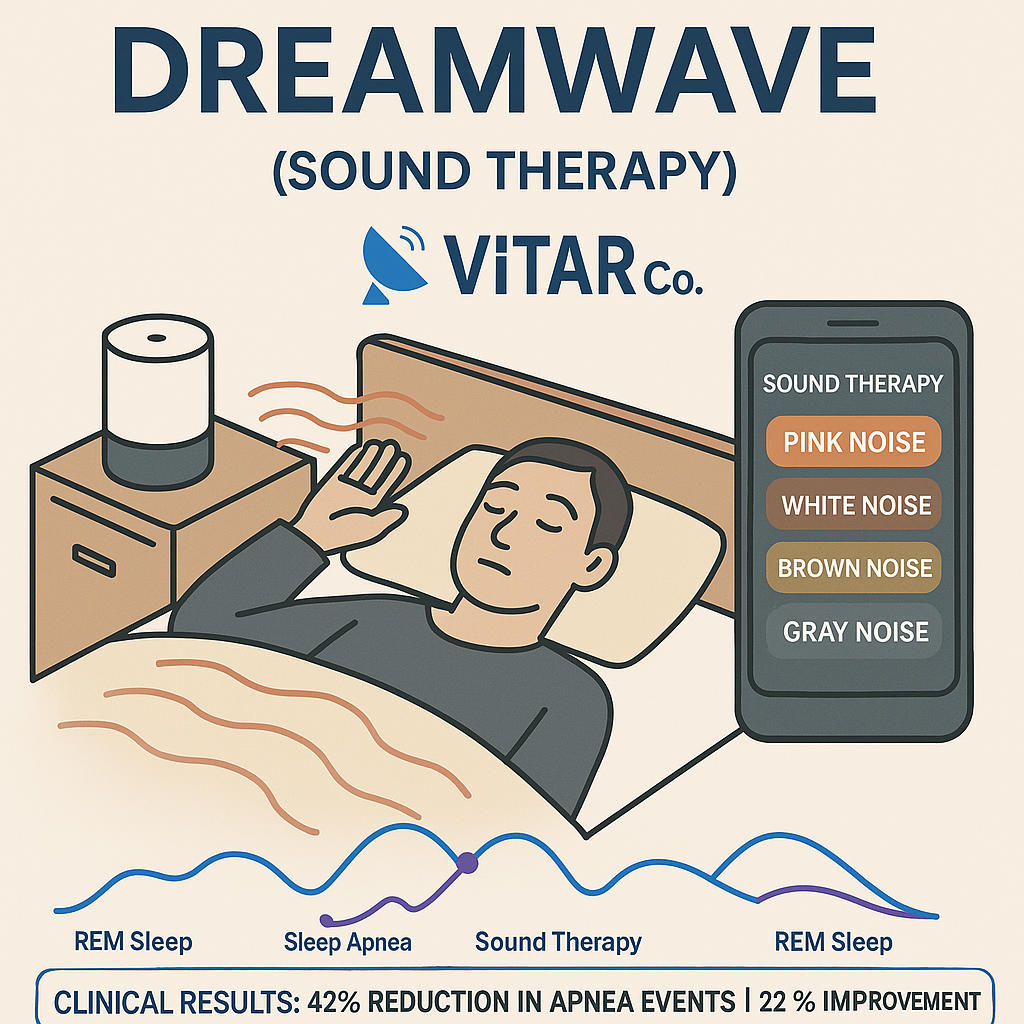
Building on our V-Ray technology, we are developing next-generation telehealth solutions including DreamWave (sound therapy), NeuroSync (non-invasive vagus nerve stimulation), and NeuroBalance (tDCS therapy). These innovative technologies have demonstrated remarkable efficacy, reducing sleep apnea incidents by 42%, improving sleep quality by 22%, and decreasing snoring by 37%.
ViTAR collaborates with leading medical institutions in Korea, including Seoul National University Bundang Hospital, CHA University, Jeonbuk National University, and Hanyang University, to validate clinical effectiveness. With our product launch scheduled for 2025, we aim to achieve a 5% market share in both global and domestic sleep monitoring markets by 2030.
Building on our V-Ray technology, we are developing next-generation telehealth solutions including DreamWave (sound therapy), NeuroSync (non-invasive vagus nerve stimulation), and NeuroBalance (tDCS therapy). These innovative technologies have demonstrated remarkable efficacy, reducing sleep apnea incidents by 42%, improving sleep quality by 22%, and decreasing snoring by 37%.
ViTAR collaborates with leading medical institutions in Korea, including Seoul National University Bundang Hospital, CHA University, Jeonbuk National University, and Hanyang University, to validate clinical effectiveness. With our product launch scheduled for 2025, we aim to achieve a 5% market share in both global and domestic sleep monitoring markets by 2030.